Local SEO vs AEO: A 2026 Guide for St. George Businesses
How to combine Local SEO and Answer Engine Optimization (AEO) to win in AI-driven search. A practical guide for businesses in St. George and Southern Utah.
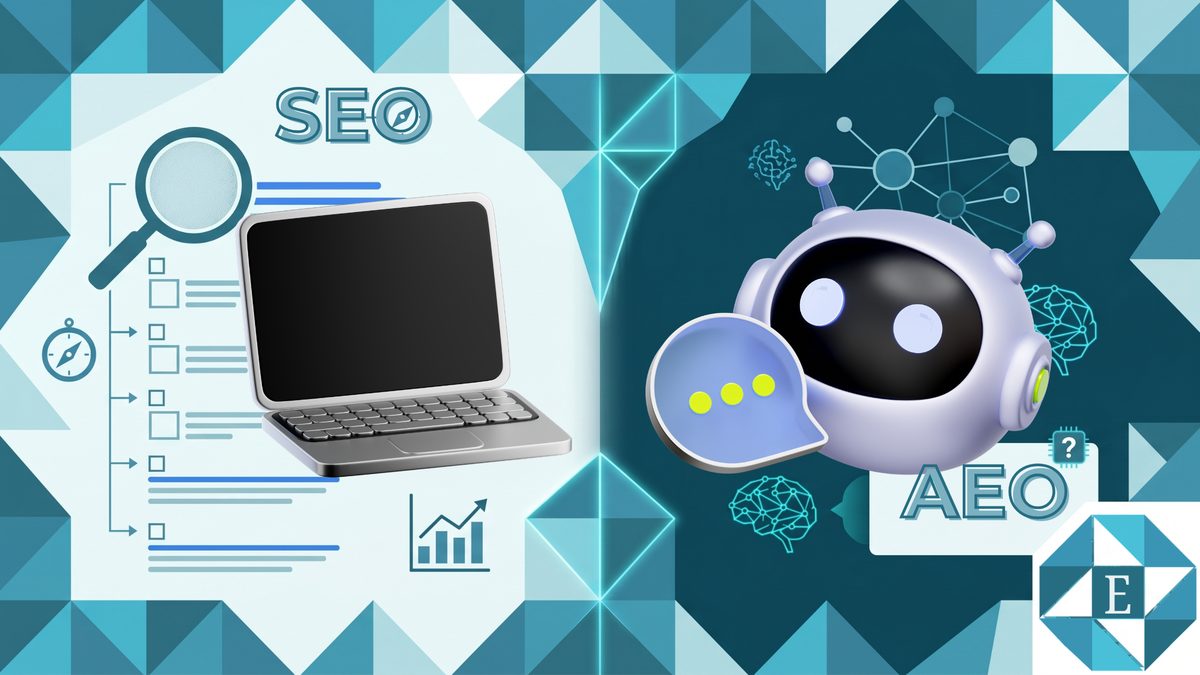
Search has fundamentally changed. Customers no longer just type fragmented keywords and click blue links. They ask full questions and expect direct answers from AI assistants like ChatGPT, Gemini, and Google's AI Overviews. For St. George businesses competing in one of the country's fastest-growing markets, winning in 2026 means optimizing for both traditional Local SEO and Answer Engine Optimization (AEO).
Here's what that actually looks like.
What's the difference between SEO and AEO?
Traditional SEO optimizes your website to rank on search results pages like Google and Bing. The goal is clicks to your site.
AEO (Answer Engine Optimization) structures your content so AI assistants and voice search can extract direct answers and cite your business as the authoritative source. The goal is being the answer, even when no click happens.
They aren't competitors. AEO is built on top of solid SEO. You need both.
| Traditional SEO | AEO | |
|---|---|---|
| Goal | Rank on SERPs, drive clicks | Be cited as the trusted answer |
| Where it shows up | Google, Bing, Yahoo | ChatGPT, Gemini, Siri, Alexa, AI Overviews |
| User intent | Keywords ("HVAC repair St George") | Conversational ("Who's the best HVAC repair in St. George?") |
| Best content format | Long-form, keyword-optimized articles | Concise 40-60 word answers in Q&A structure |
| Authority signals | Backlinks, domain authority, NAP consistency | Entity confidence, schema markup, co-occurrence |
| Key metric | Organic traffic, rankings, CTR | AI citation frequency, featured snippets, voice mentions |
Why St. George is a high-stakes market
St. George was just named the top small metro in the U.S. by the Milken Institute's 2026 Best-Performing Cities report. That growth, driven by tourism, in-migration, and a booming home services sector, has created a brutally competitive search environment.
Tourists searching "best restaurants near Zion" or "hotels in St. George" have zero local loyalty, so visibility wins. New residents searching for HVAC, plumbing, real estate, or contractors default to whoever shows up first, whether that's the Google map pack or an AI recommendation. If you aren't optimized for both channels, you're invisible.
Local SEO foundations that still matter
Your Google Business Profile is the anchor
Your Google Business Profile (GBP) is no longer just a directory listing. It's the structured data feed AI uses to verify your business exists. Inconsistencies kill you.
NAP consistency (Name, Address, Phone) used to just prevent algorithm confusion. Now it directly affects "entity confidence," an AI's certainty that your business is real. A missing suite number on Yelp versus Google can be enough for an AI to skip you entirely. Confused AI = invisible business.
Beyond accuracy:
- Upload high-quality original photos (skip stock imagery)
- Build steady review velocity with detailed, keyword-rich testimonials
- Respond to every review, because AI parses sentiment, not just star counts
Use semantic clusters, not keyword stuffing
Modern algorithms reward natural variation. Instead of "St George web design St George website services," write naturally about "website design in Southern Utah," "local SEO for service businesses," and "digital marketing in Washington County." Same topical relevance, far better readability for both humans and AI.
Co-occurrence beats backlinks alone
Backlinks still matter, but co-occurrence (being mentioned alongside related local entities like "Zion National Park," "Washington County," or local landmarks) is increasingly how AI builds its mental map of your business. Local press mentions, Chamber of Commerce features, and partnerships with regional brands all build this signal, even without a hyperlink.
How to actually win at AEO
Optimize for the zero-click reality
Over half of searches are now conversational, and roughly 70% of smart speaker users query their devices daily. The user shift is from "best running shoes 2026" to "What are the best running shoes for beginners in 2026?"
Being the cited source in an AI Overview or voice answer is the new top spot. Even without a click, you get brand exposure, authority, and often the eventual conversion.
The 40-60 word rule
AI extraction algorithms strongly prefer answers between 40 and 60 words. Structure key content like this:
- H2 or H3 heading = the question ("How much does emergency HVAC repair cost in St. George?")
- First paragraph = the 40-60 word direct answer
- Following paragraphs = deeper context for human readers
This dual-purpose structure satisfies both AI extraction and SEO dwell-time.
The four-step conversational framework
For every key page or article, follow this pattern:
- Lead with the real problem. "Lost water pressure in your St. George home?" beats "St George plumber services."
- Give a direct, factual answer. 40-60 words. No fluff.
- Add local context. Reference Southern Utah's climate, geography, or conditions. This signals geographic expertise.
- End with a clear CTA. "Call our 24/7 Washington County dispatch line" is specific and frictionless.
The technical side: schema and speed
Stack your schema markup
Generic LocalBusiness schema isn't enough anymore. Use the most specific schema type for your vertical (Plumber, HVACBusiness, RealEstateAgent, Restaurant, etc.) and stack multiple schema types:
- Service schema for each service you offer
- FAQPage schema for your 40-60 word Q&A blocks (pages with FAQ schema see roughly 30% higher CTR)
- Review schema for aggregate ratings and testimonials
- Person and Author schema to build E-E-A-T signals
This is JSON-LD code in your site's head, and it's easy to mess up if you aren't comfortable with custom development.
Speed isn't optional
AI prefers fast sources. Even a 100ms delay in load time correlates with measurable drops in conversion. Your Core Web Vitals (LCP, FID, CLS) need to be solid, especially on mobile. This is why bloated, unoptimized sites often lose to lean, well-built ones in competitive markets.
E-E-A-T and AI reputation management
Google and AI models both evaluate Experience, Expertise, Authoritativeness, and Trustworthiness. To prove it:
- Attribute every article to a real, named author with a verifiable bio
- Publish original case studies with real client results
- Use original photography, not stock
- Monitor unstructured mentions on Reddit, forums, and social, since AI scrapes all of it for sentiment
If a local Reddit thread trashes your brand, an AI will likely exclude you from recommendations no matter how strong your traditional SEO is. Proactive reputation management is now part of search.
The metrics that actually matter
Forget vanity metrics. Track:
- AI Visibility Score: how often you're cited in ChatGPT, Gemini, and AI Overviews
- Citation count: mentions and co-occurrences across the web
- Lead velocity: direct calls, form fills, booked appointments
Traffic might plateau even as revenue climbs, because AEO captures users before they ever reach your site. Measure the right thing.
Your implementation roadmap
- Audit: Technical SEO, schema, NAP consistency, mobile speed, Core Web Vitals
- Rebuild content: Conversational framework, 40-60 word answers, semantic clusters
- Stack schema: Service, FAQ, Review, LocalBusiness, Person
- Build local authority: GBP optimization, co-occurrence PR, review management
- Iterate: AI algorithms update constantly. Static sites go invisible.
FAQ
Is AEO replacing SEO?
No. AEO is built on top of SEO. Search engines still need to crawl and index your content before AI can cite it. Strong technical SEO is the prerequisite for AEO success. The two work together, not against each other.
How long does it take to see AEO results?
Most local businesses see meaningful AI visibility shifts in 3-6 months with consistent execution. Schema implementation and FAQ content can surface featured snippets within weeks; building entity confidence and co-occurrence signals takes longer.
Do I need to throw out my current website?
Usually no. Most AEO improvements layer onto an existing site: rewriting key pages with the 40-60 word framework, adding FAQ schema, fixing NAP consistency, and improving Core Web Vitals. A full rebuild is only needed if your foundation is broken.
What does this cost for a local business?
It varies based on scope. A solid Local SEO and AEO program for a small St. George business typically runs $1,500-$5,000 per month for ongoing work, plus any one-time technical or content overhaul. Cheaper "SEO packages" almost never include the AEO and technical depth needed to compete in 2026.
Need help putting this into action?
At Elevate Growth Solutions, we build and maintain custom websites on any platform, from custom code to WordPress and other builders, plus full-stack marketing strategies for businesses in St. George, Washington County, and across Utah. If you'd like a baseline audit of your SEO and AEO setup, book a discovery call.